

Introduction
When you hear the name W.E.B. Du Bois, what comes to mind? A serious scholar. A civil rights pioneer. The co-founder of the NAACP. The author of The Souls of Black Folk. You probably think about double consciousness, activism, and social change.
What you probably don’t think about is laughter.
Here’s the thing. Du Bois authored seventeen books over his lifetime, including five novels, according to the Hutchins Center at Harvard. He trained as a sociologist and documented the oppression of Black people with precision and purpose. But buried inside his literary works is a sharp, intelligent wit that most readers miss.
I am talking about satire that cuts deep. Irony that makes you smirk. And humor that sneaks up on you when you least expect it.
Think about the relationship between comedy and truth. Du Bois understood this connection better than most. His humor was not about cheap jokes. It was about using laughter to reveal hard truths about race, power, and American life. In many ways, his approach feels fresh in 2026, when readers are looking for books that entertain while also making them think.
This article fills a gap. If you have searched for funny books only to find the same old names over and over, you are in for a treat. We are going to explore how one of America’s most respected thinkers also knew how to make people laugh.
By the end, you will see Du Bois in a new light. You will discover entry points into his humor. And you might just find your next favorite read among the web dubois books that showcase his wit.
Ready to laugh at something you never expected? Let us begin.

Browse Rankings to discover more books that blend humor with heart.
The Many Faces of W.E.B. Du Bois: From Scholar to Satirist
So you know Du Bois as a serious scholar. But here’s the thing. He was not just one thing. Over his long career, he wore many hats. He was a historian, a novelist, an editor, a sociologist, and a co-founder of the NAACP, as noted by the NAACP. He even completed graduate work at Harvard University, where he became the first African American to earn a doctorate, according to Wikipedia. With all that going on, you might think he had no room for humor.
But you would be wrong.
Each role he played gave him a different way to use laughter. As a sociologist, he used irony to point out injustice. As a fiction writer, he created characters who made you smirk. As a journalist, he wrote editorials that dripped with dry wit. The Hutchins Center at Harvard notes he authored seventeen books, including five novels. Some of those novels are pure satire.
Du Bois also spent time in Germany during his early training. There he soaked up European satire and sharp, intellectual humor. That influence stayed with him. He learned that jokes could be weapons. They could cut through lies faster than anger ever could.
Even his personal letters show a man with a sly sense of humor. Friends and colleagues remembered him as someone who could make a room laugh with a single raised eyebrow. He was not the stiff professor so many imagine.
If you love finding humor in unexpected places, you might enjoy other authors who hide laughs beneath serious subjects. Check out our piece on Langston Hughes novels that are funnier than you think. It is the same kind of surprise.
Now that we see Du Bois as more than a scholar, let us look at the specific books where his comedy shines.
Browse Rankings to discover more books that blend humor with heart.
The Souls of Black Folk (1903): Irony as a Rhetorical Weapon
Most people think of The Souls of Black Folk as a sad book. It is famous for talking about the "Veil" that separates Black and white America. And yes, there is a lot of sorrow in it. The book introduces the idea of double consciousness, the feeling of always looking at yourself through the eyes of others. It is a heavy read.
But here is the thing. It is also a very sharp book.
Du Bois was angry about how the country treated Black people after the Civil War. But he did not just shout about it. He used irony. One scholar calls his style "militant irony," as described in The Politics of Laughter in African American Modernism. That means he used humor as a weapon. He used polite words to point out ugly truths.
Du Bois stands apart from most american authors in how he does this. He lets the facts do the work. He shows you what America says it believes. Then he shows you what America actually does. The gap between those two things is where the dark comedy lives.
The best example is his chapter on Booker T. Washington. Washington had a plan. He told Black Americans to focus on learning trades and working hard. He said to stop asking for civil rights and voting rights for now. Du Bois thought this was a terrible mistake. You can see this tension explained clearly by Columbia University.
So how does Du Bois argue against him? He does not scream. He uses irony. He politely points out the contradictions. He shows that Washington was asking people to give up the very things that make a person free. He uses Washington’s own words to show how the plan would never work. It is brilliant. It is cutting. And it is funny in a dark, knowing way.
Why do so many readers miss this humor? Because they come to the book expecting only sadness. They read "Of the Sorrow Songs" and they cry. They forget that Du Bois also wrote chapters that drip with sarcasm. He presents the conundrum of a religious white America that allows racism, as noted by Princeton University. He does not answer it with a lecture. He answers it with a raised eyebrow.
If you want to find more books that use this kind of smart, sharp humor, we can help. We find the novels that make you nod and smile at the same time. Browse Rankings to see our list of the best satirical books that will make you think while you laugh.
Darkwater (1920): The Unvarnished Truth and Its Bitter Laughs
If you think Du Bois’s irony was sharp in The Souls of Black Folk, wait until you see what he wrote in 1920. By the time Darkwater came out, World War I had ended, but the hope for racial progress had not arrived. Du Bois was tired. He was angry. And his humor got darker.
Darkwater is a different kind of book. It mixes autobiography, essays, and even short fiction. It feels more personal and more bitter. According to the National Endowment for the Humanities, the book is “steeped in rage” and shows Du Bois at his most frustrated with white supremacy. That anger did not kill his humor. It just made it sharper.
The most surprising part of Darkwater is a short story called “The Comet.” It is a piece of speculative fiction. A Black man and a white woman are the only survivors after a comet’s toxic gas kills everyone else. In that moment, race no longer matters. They can see each other as human beings. The satire hits you hard. Du Bois uses a science fiction setup to point out how silly and cruel racial divisions are. It is funny because it is so ridiculous. It is also heartbreaking because we know the real world does not work that way.
This kind of dark humor takes courage. Du Bois was not trying to make people feel cozy. He wanted to show the truth. And sometimes the truth makes you laugh even when you want to cry.
If you enjoy Du Bois’s sharp, satirical side, you might also like the work of other American authors who use humor to tackle serious topics. Check out our piece on Langston Hughes novels are funnier than you think to see another master of the form.
And if you want more books that mix wit with wisdom, Browse Rankings to find your next laugh and your next thought.
Du Bois’s Fiction: The Quest for Dark Princess and The Black Flame
Most people know Du Bois as a scholar. But he was also a novelist. According to the Hutchins Center at Harvard, he authored seventeen books, including five novels. That fiction side is where his humor really got room to breathe.
In 1928, Du Bois published Dark Princess. On the surface, it is a romance novel. A Black American man falls in love with a beautiful Indian princess. But do not let the love story fool you. Du Bois uses the romance to take aim at two targets at once: white supremacy and black nationalism. He pokes fun at how both sides think they have all the answers. The satire is gentle at times and sharp at others. It is the kind of book that makes you smile while also making you think. If you love when laughter and lessons mix, you might enjoy discovering other American authors who blend humor with social commentary. For a similar feel, check out our piece on Langston Hughes novels are funnier than you think.
Then came The Black Flame trilogy. Du Bois wrote these three novels between 1957 and 1961, near the end of his life. The series follows a fictional Black family across generations. Du Bois uses irony to show how slow real progress is. He mocks the idea that society is moving forward in a straight line. The trilogy is epic in scope but grounded in a wry, knowing tone. It asks: Have things really changed? And then it laughs at the answer.
Fiction gave Du Bois a playground. He could try out jokes and irony in ways his essays never allowed. The stories let him show absurdity instead of just arguing about it. That made his point land harder.
If you love books that mix sharp humor with big ideas, you are in the right place. Browse Rankings to see more authors and novels that will make you laugh and think at the same time.
Du Bois in the Context of American Humor: Twain, Chesnutt, and Thurber
Du Bois did not invent funny writing out of thin air. He belonged to a deep tradition of American authors who used laughter to tell hard truths. Think of Mark Twain. Twain skewered racism, hypocrisy, and greed in novels like Adventures of Huckleberry Finn. He made you chuckle first, then slapped you with a point. Du Bois did the same thing. His satire in Dark Princess and The Black Flame works the same way. It sneaks up on you.
But there is a closer link. Charles W. Chesnutt, a Black writer from the late 1800s, used similar tools. According to the Annenberg Learner, Chesnutt’s Uncle Julius stories are full of "subversive humor and irony" that "subtly satirize nineteenth-century white people’s condescending stereotypes." Sound familiar? That is exactly what Du Bois did in his fiction. He used a gentle laugh to knock down big ideas. The two writers even talked shop. In 1926, Du Bois sent Chesnutt a questionnaire for The Crisis asking how Black people should be shown in literature. They were both thinking about how comedy can serve justice.
Then there is James Thurber. Thurber was a master of understated wit. His stories turn small moments into big jokes. Du Bois had that same quiet, knowing wink. He did not need to shout. He could slip a joke into a sentence and let you find it. That style is rare. When you read Du Bois’s novels next to other great American authors, you see the pattern. They all knew that the best way to change a mind is to make it laugh first.
If you want to discover more funny fiction that packs a punch, start with our curated rankings. They are built for readers who love a good laugh with real meaning. Browse Rankings to find your next favorite book.
Why Du Bois’s Satire Resonates Today: Lessons for the Modern Funny Reader
You might think a writer from the early 1900s would feel old and dusty. But here is the thing about Du Bois’s satire. It feels like it was written for 2026. His critiques of systemic racism and inequality are still painfully relevant. And his humor offers a timeless way to cope with heavy truths.
Think about it. When you laugh at something unfair, you take away some of its power. Du Bois knew that trick well. He used sharp wit and gentle irony in his novels to make readers stop, think, and maybe smile. According to Wikipedia, Du Bois was not just a scholar but also a "Pan-Africanist civil rights activist" who used every tool he had to fight for justice. Humor was one of those tools.
Modern readers who crave smart, socially conscious comedy can find a goldmine in his works. I am talking about books like The Souls of Black Folk where he mixes deep sociological insight with moments of dry observation that still make you grin. That mix of truth and laughter is rare. But it is exactly what many of us look for today when we want entertainment with meaning.
Book clubs and comedy enthusiasts are rediscovering Du Bois’s wit through new editions. Penguin Random House has kept his titles in print for a reason. People want to read something that makes them laugh while also teaching them something real. That is Du Bois’s specialty.
If you love authors like Mel Robbins or Jenny Han, do not be afraid to pick up a Du Bois novel. Yes, his topics are serious. But his delivery is often funny. He proves that the best day of your life as a reader can come from a book that makes you chuckle while opening your eyes.
For more writers who blend humor with social commentary in unexpected ways, check out our article on Langston Hughes novels. Hughes carried that same tradition forward.
And if you want a modern series that keeps that spirit alive, start with a book that mixes absurd comedy with real heart. Read Book 1 and see how laughter can still change the way you see the world.
How to Explore Du Bois’s Wit: A Reading Guide for Humor Seekers
So you want to discover the funny side of Du Bois. Good news. You do not need to be a scholar to find his wit. You just need to know where to look.
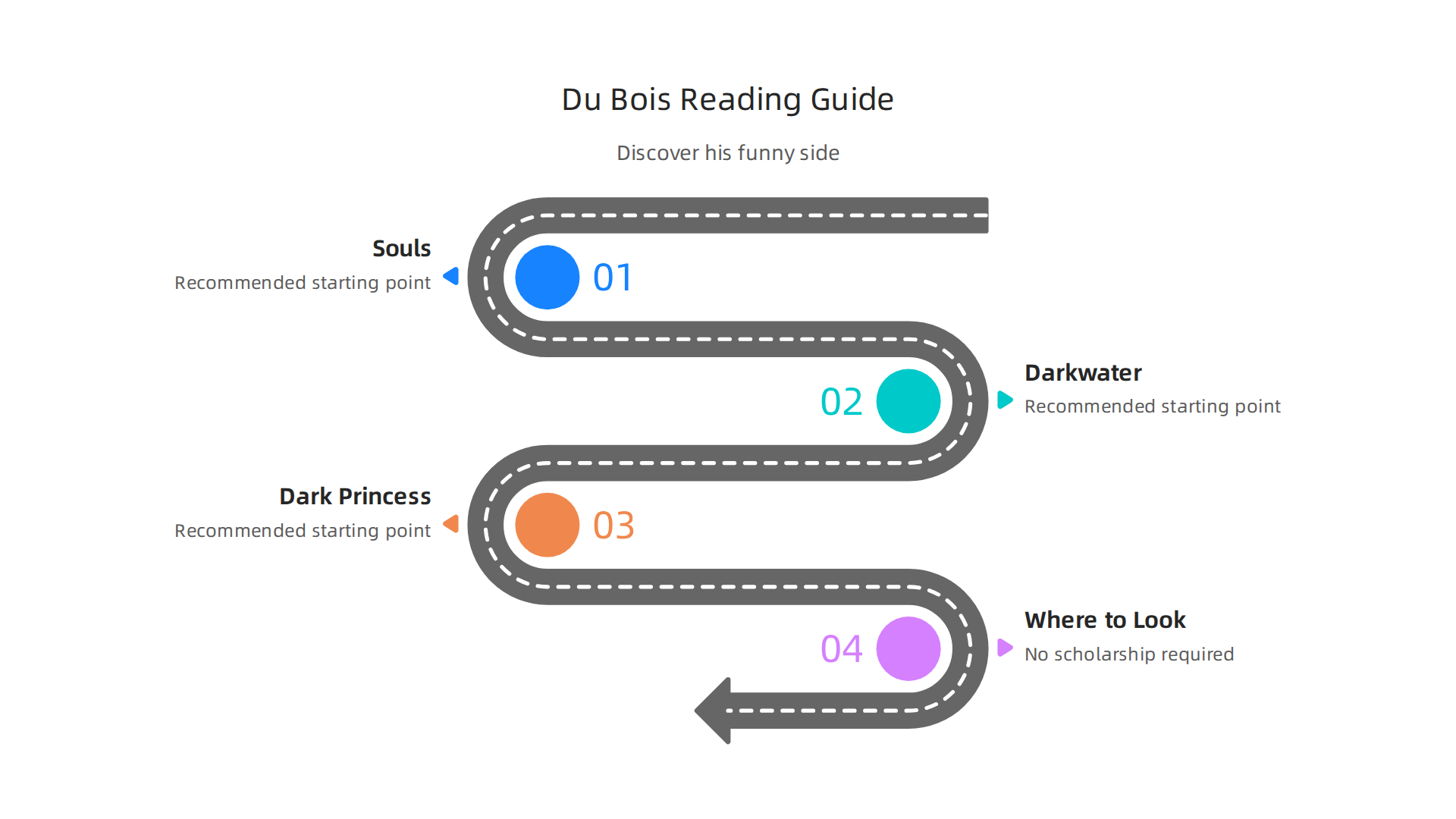
Start with The Souls of Black Folk. This is his most famous book for a reason. It blends deep sociology with moments of dry irony that still land today. According to Britannica, Du Bois used his "literary talents" alongside his academic background to write this book. The result is a work that makes you think and sometimes chuckle. The chapter on the "double consciousness" of black Americans is heavy. But his observations about white ignorance have a sharp, almost sarcastic edge.
Next, try Darkwater. This collection of essays and short fiction turns up the satirical heat. Du Bois gets more direct here. He mocks the absurdity of racism with a sharper tone. You can find free e-texts of many of his works at W.E.B. Du Bois primary sources. It is a great way to browse his humor without spending a dime.
For something closer to a novel, pick up Dark Princess. This is a narrative driven story about a black American who travels the world. The humor here comes from the characters and their interactions. Du Bois uses dialogue to reveal the ridiculous side of prejudice. It is a fun entry point if you prefer stories over essays.
Finally, pair your reading with scholarly essays that point out the comedic passages. The article from ScholarWorks about Du Bois and the "Great Books" shows how his work fits into the larger literary tradition. These secondary sources can help you spot the jokes you might miss on a first read.
Do not limit yourself to just one type of Du Bois book. Try nonfiction for intellectual wit. Try fiction for character driven humor. Both have something to offer. And if you enjoy this mix of comedy and social commentary, you might also like other American authors who use humor to tell hard truths. Check out our article on Langston Hughes novels for more.
If you want to know where to find funny books beyond classic authors, visit our guide to finding funny books at Books A Million. It can point you toward new favorites.
And when you are ready for a modern series that keeps Du Bois’s spirit alive with absurd comedy and real heart, Read Book 1. See how laughter can still change the way you see the world.
Summary
This article uncovers the often-overlooked humor in W.E.B. Du Bois’s work, showing how a famed scholar and activist also used irony, satire, and dark comedy to reveal racial injustice. It surveys specific books—most notably The Souls of Black Folk, Darkwater, Dark Princess, and The Black Flame—and explains how Du Bois used rhetorical wit, speculative fiction, and narrative play to make sharp social points. The piece places his humor in an American tradition alongside writers like Mark Twain and Charles W. Chesnutt, and argues that his satire still resonates with readers today. Practical reading advice shows where to spot jokes, which titles to start with, and how secondary scholarship can highlight overlooked comic passages. Whether you prefer essays or fiction, the guide helps you find Du Bois’s wry voice and explains why laughter can be a powerful tool for critique. By the end, readers will be able to recognize Du Bois’s comedic strategies, choose entry-point texts, and appreciate how wit complements his political and literary ambitions.